John 20:1-9
Mary found the tomb open and told Peter. He and another disciple ran, saw the cloths, entered, and believed Jesus rose.
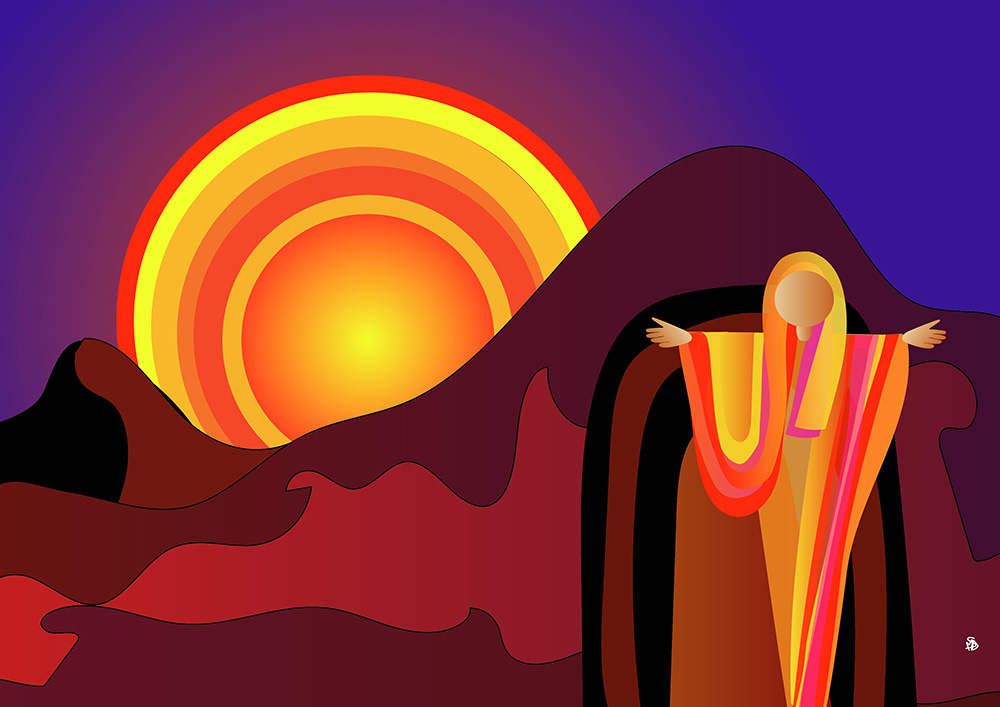
There is something quietly unsettling about John 20:1-9.
On Easter morning, there is no radiant appearance, no voice breaking the dawn, no heavenly hosts, no encounter with the risen Christ.
There is only absence.
Mary Magdalene comes in the half light and finds the stone rolled away. Peter and the beloved disciple run, breathless with confusion. They see the linen cloths. They see the emptiness. And somehow, mysteriously, they believe.
But what do they believe in, when there is nothing yet to see? This is where Easter begins, not with certainty, but with a threshold. A space between loss and recognition. A moment suspended between death and life.
Perhaps their belief did not begin in the tomb at all. Perhaps it was seeded long before, on the shores of the Sea of Galilee, when a man once said, “Come, follow me.” They left their nets then, but maybe this is the moment they truly follow, when there is no Jesus to look at, no miracle to grasp, only a memory, a promise, and an empty space where death should have the final word. This is the fragile, courageous beginning of Resurrection faith.
It reminds me of that final scene in Hamnet, where Agnes, played by Jessie Buckley who just won the Academy Award, still aching from the death of her son, comes to see what has been born from grief. In Shakespeare’s writing, she recognises something beyond loss, a love that has not been extinguished, a life that has taken on another form. She does not “see” her son as he was, but she perceives him, transfigured through story, through beauty, through creation. It is not proof. It is recognition. And perhaps that is what happens at the tomb.
The disciples do not yet see the risen Christ, but they begin to perceive that death is no longer what it was. Something has shifted. Something has been conquered.
The mystery is not solved, it is opened.
And we, too, stand in that same space. Our hope is not built on having seen everything clearly. It is carried in the witness of the Gospel writers, in the bold proclamation of Saint Paul, and in the quiet, persistent stirring of faith that tells us, life is stronger than death.
I remember, as a child, asking my mum why we always sat in the same seat at church. I assumed there must be a practical reason, she is, after all, wonderfully sensible and practically minded woman.
But she surprised me.
She said, “I sit with Christ on the right side of God.”
It was such a simple answer, and yet it has stayed with me. Because it wasn’t about the seat at all. It was about where she believed she belonged and revealed to me for the first time her very deep faith.
In the second reading, Colossians 3:1-4 we are told, “Seek the things that are above, where Christ is, seated at the right hand of God.” Easter faith is this quiet reorientation. A choosing to live as though the Resurrection is already true. A decision to “sit” in a place shaped not by death, but by life.
So how is this a celebration, when Jesus has not yet appeared? Because even in absence, something has begun. The world is no longer closed in on itself. The tomb is not the end. The story is not finished.
The Resurrection is already unfolding, in trust before sight, in hope before certainty, in love that refuses to believe death has the final say. And our call this Easter is the same, to be people of the Resurrection. To live as those who know where Christ is. To take our place, not in fear, not in despair, but at the right hand of God.
Not because we have seen everything clearly, but because, like Mary, like Peter, like the beloved disciple, we have dared to believe that life has already begun again.
So this Easter, I’ll keep choosing the place of Resurrection, and if I’m honest… I still don’t feel entirely comfortable sitting on the left-hand side of the church!
Virginia Fortunat